KU Eichstätt-Ingolstadt
Am Marktplatz 2
85072 Eichstätt
Zahra.Chhapra@ku.de
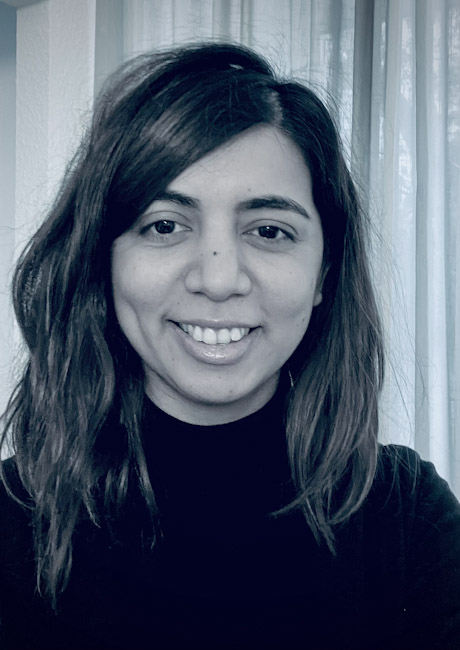
Zahra Chhapra, is as a PhD researcher at the ‘Practicing Place’ Research Group at the Katholische Universität Eichstätt-Ingolstadt (KU) since April 2024. She completed the COOP Design Research Masters (M.Sc) from the Bauhaus Foundation and Hochschule Anhalt in Dessau in 2019 and previously gained a bachelor’s degree in architecture (B.Arch) from Mumbai University in 2014.
Zahra has worked with renowned researchers, architects and artists in India and Europe. She worked as an architect in Goa, an archivist in Mumbai, a teaching assistant in Pristina, an artist assistant in Ljubljana and a researcher, editor, and architecture tour guide in Berlin. Living in different places has heightened her observational skills and fuelled her curiosity about distinct socio-spatial and cultural practices of urban and rural societies. Furthermore, the various professional experiences have given her a vast skillset and an excellent overview of the architecture and research world. She brings her distinct international personal and professional knowledge to her new role as a PhD researcher at the Practicing Place research group at the Katholische Universität in Eichstätt. She is eager to build her PhD research on complex and heterogeneous urban practices, especially foregrounding examples from the Global South.
Zahra’s research, Social Life of Walls in Bombay / Mumbai, follows walls, fences, and other perimeter boundary objects across the city of Mumbai (formerly Bombay). It advocates empirical research methods that trace walls in their everyday surroundings and pay close attention to the details of events as they unfold in real time and place. The research seeks to present a cohesive analysis of a crucial yet often overlooked element of the contemporary urban landscape. In doing so, it contributes to a deeper understanding of the social life of walls in cities. Below is an elaborated abstract of her project.
Social Life of Walls in Bombay / Mumbai
This dissertation traces the social life of walls in the city of Mumbai, formerly known as Bombay. The project follows walls, fences and wall-like boundary objects that surround single standing buildings through the important milestones in the past and present of the city.
Walls and fences enclosing apartment buildings, schools, parks, religious spaces, office buildings or any built and unbuilt piece of land on a local urban level are the dominant architectural and urban typology around the world. Yet, unlike national border walls, boundary walls within our cities and neighbourhoods are rarely critically analysed, even less so in the context of the cities of the global south.
Due to the scarcity of critical thought and discourse on perimeter walls and fences within our cities, the narrative of national border walls is often borrowed, which further dilutes their intention. In western academic discourses, the wall between the US and Mexico, between Israel and the West Bank, the Berlin Wall and the walls of gated communities are evoked when the topic of walls and fences is addressed. Such narratives accuse walls and fences in neighbourhoods of building landscape of fear and paranoia. In this dissertation I argue that, instead of evoking generalized moralities of national border walls when talking of walls and fences in cities and neighbourhoods, we need to study those walls and fences in cities and neighbourhoods as their own unique objects, holding within them the story of the city and its unique histories.
The task of decolonizing walls of western reductionist epistemologies and thought requires a strong theoretical framework which does justice to their agency. I advocate empirical research with methods inspired by ethnographic research and Actor-Network Theory (ANT). ANT allows the research to move beyond moralizing interpretations of walls and first locate the walls back in their local context. By following walls in time and place and paying close attention to details of events as they unfold, the research foregrounds the many shapes and shades of walls and wall-like objects and the social, political, economic and historic scenarios in which they are situated.
In this PhD research project, I follow walls and fences of the city of Mumbai. My empirical research in the city of my birth takes me through the life and journey of walls and fences through the changing realities of the city. Fort walls at the inception of Bombay as an East-India Company trade-post, masonry walls around the bungalows of wealthy Europeans and Indians in their eighteenth and nineteenth century homes in the city, wrought-iron fences exported directly from London along with urban planning and ideas of public improvement, walls as street façade developers in the garden city planning of the twentieth century expansion of Bombay and the walls and fences of redevelopment projects today are some of the cases that come forward through my research. The dissertation argues that everyday perimeter walls in Mumbai are not merely defensive or exclusionary structures, but urban actors that materialize the city’s shifting histories of property, planning, security, and social coexistence.
The research presents a cohesive volume on an important and highly recurring object of the contemporary urban landscape of Mumbai. It demands attentiveness to the multiplicity of actions that cohere around it, and to the quiet processes through which urban materialities sustain and transform social life. This way, walls become less a metaphor of fear and more a method of inquiry. To study the walls ethnographically is to study the city itself—its rhythms, its frictions, and its capacities for coexistence.
The dissertation is therefore an important contribution to our understanding of the social life of walls in our cities. It contributes to object-oriented philosophy, urban regional sociology, anthropology of practice, Actor-Network Theory research in urban studies and territoriology. It is relevant to sociologists, urbanists, architects and town planning authorities.